OpenAI has updated “Dots”—an AI agent for ChatGPT designed to work across connected applications and perform tasks on behalf of users. This update aims to improve the agent’s response speed and task-execution efficiency, while also granting users greater control over its behavior. When OpenAI first introduced Dots, it was positioned as a tool capable of handling background processes—including complex, multi-step tasks that span various applications. This latest update further enhances those existing capabilities.
ChatGPT Dots Now Support Custom Instructions for Faster, More Precise Responses
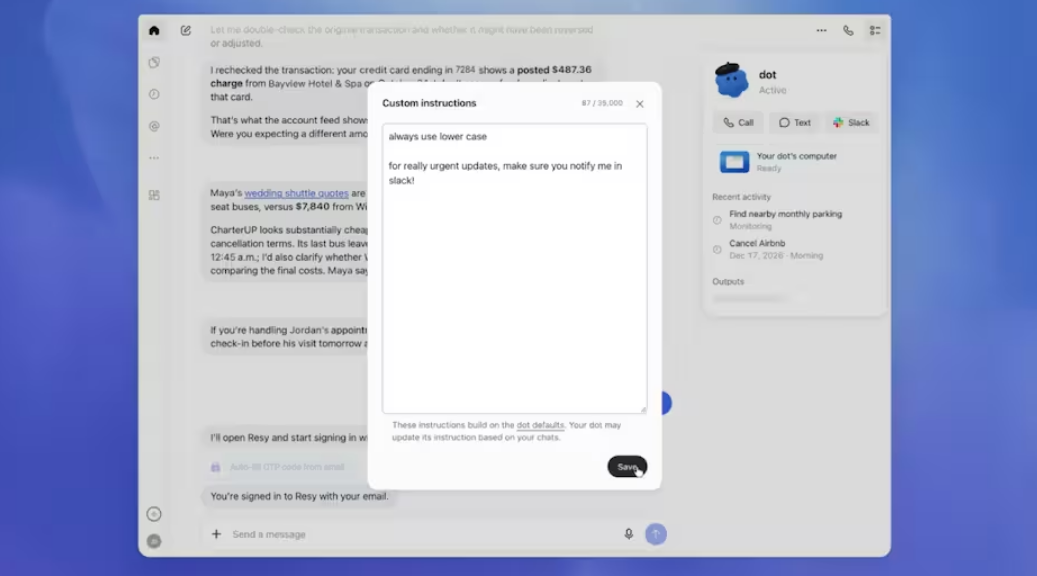
In an announcement, OpenAI stated that ChatGPT Dots are now faster, more concise in their communication, and more effective at executing tasks. Users can now provide “custom instructions” to define how the agent behaves. For instance, a user could specify a preference for lowercase text, and the agent will consistently use lowercase in its responses. Users can also instruct the agent to draft emails and present the drafts for review before they are sent.
These instructions can be added while chatting with Dot. Users can also modify them later in the settings—on mobile devices, this option is found under “Customize” > “Behavior,” while on the web and desktop versions, it is located within Dot’s menu.
This differs from the existing permission and approval settings in Dot. Users can control which connected applications an agent is permitted to access and determine when explicit authorization is required to perform specific actions. OpenAI also allows users to establish custom rules for particular tasks—for instance, requiring Dot to seek approval before sending a message or modifying a shared file.
In September, OpenAI introduced “Dots”—AI agents capable of executing tasks in the background, even after a user has left the ChatGPT interface. Each agent is equipped with its own dedicated cloud-based computing environment and browser, enabling it to access connected applications, conduct research, analyze information, and prepare documents. Users can monitor the progress of these agents at any time and provide further instructions while tasks are underway.
Dots has recently added support for Apple’s iMessage and Android’s Rich Communication Services (RCS), allowing users to send messages, photos, and voice notes to customer support representatives via these platforms. Dots can also use these channels to send updates. This feature is currently being tested in the United States with eligible ChatGPT Pro subscribers.